


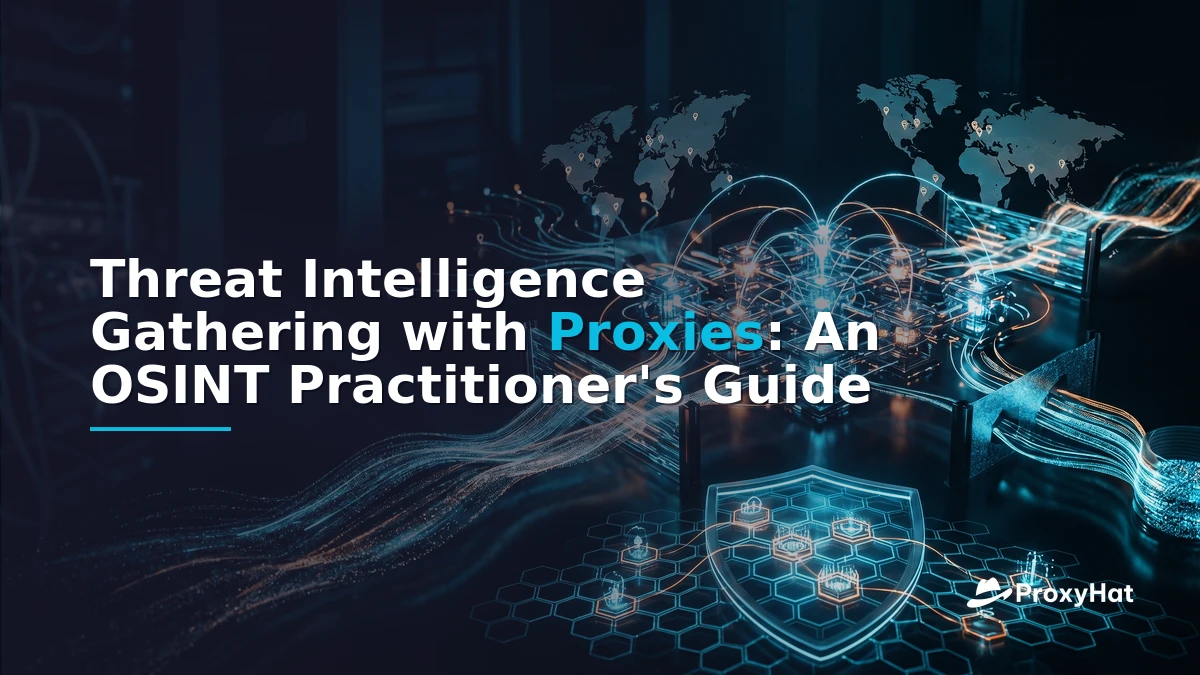
Threat intelligence gathering with proxies is a foundational capability for SOC analysts, OSINT researchers, and brand-protection teams who need to collect security-relevant data from public sources without exposing their organizational infrastructure. Whether you are monitoring cybercrime-adjacent clearnet sites, ingesting IOC feeds, or tracking brand abuse across paste sites, proxy-mediated collection is what keeps your research attributable, scalable, and safe.
Legal caveat: Every technique described in this article must be used only within engagements that are explicitly scoped and authorized. Do not access systems you are not permitted to access, do not use credentials that do not belong to you, and do not violate applicable laws or platform terms of service. This guide covers passive collection from publicly accessible sources and authorized security research only.
Why Threat Intelligence Gathering with Proxies Matters
Modern threat intelligence workflows depend on data collected from sources that are, by design, hostile to investigators. Cybercrime forums, paste sites, and credential-leak aggregators routinely deploy IP-based blocking, rate limiting, and fingerprinting to detect and exclude security researchers. When an analyst connects directly from their corporate IP range, three problems emerge simultaneously:
- Attribution: The target can identify the investigating organization, tipping off threat actors who then alter their infrastructure or move to new channels.
- Blocking: A single flagged IP can get permanently banned, cutting off an entire intelligence pipeline.
- Geographic mismatch: Some sources serve different content or restrict access based on the visitor's country. An analyst connecting from a US datacenter may see different forum content than a local visitor would.
OSINT proxies solve these problems by routing traffic through residential IP addresses that blend in with normal user traffic. According to the MITRE ATT&CK framework, threat actors themselves use similar techniques — residential proxy networks and VPNs — to evade detection (T1090.004). Defensive teams need the same capability to collect intelligence without alerting their adversaries.
OSINT Use Cases for Security Researchers
Monitoring Clearnet Adjacents of Dark-Web Mirrors
Many dark-web marketplaces and ransomware leak sites maintain clearnet frontends or mirror pages — sometimes intentionally, sometimes through misconfigured servers. These clearnet adjacents are valuable intelligence sources because they are accessible without Tor, making automated monitoring feasible at scale. However, they are also aggressively protected: operators use Cloudflare challenges, JS-based bot detection, and IP reputation filtering to block known datacenter ranges.
Residential proxies allow you to fetch these pages from IPs that look like ordinary residential visitors, reducing the likelihood of CAPTCHA challenges and IP bans. For broader web-scraping workflows, see our web-scraping use case guide.
Cybercrime-Forum Clearnet Frontends
Several well-known cybercrime forums operate clearnet registration pages, status checkers, or API endpoints alongside their Tor hidden services. These frontends are useful for tracking forum uptime, new registration waves, and public announcements. Monitoring them at scale requires distributed IP rotation — a single IP hitting a forum frontend every 30 seconds will be blocked within hours.
Public Paste Sites
Paste platforms like Pastebin, Ghostbin, and similar services are frequent dumping grounds for leaked credentials, internal documents, and breach announcements. Most paste sites enforce aggressive rate limits — often 60 requests per minute or fewer for unauthenticated users. A distributed collection strategy using rotating residential IPs lets you monitor multiple paste sites concurrently without hitting per-IP throttling.
Compromised-Credential Aggregators
Services that aggregate breached credentials (such as Have I Been Pwned, DeHashed, and others) provide APIs for checking whether specific email addresses or domains appear in known breaches. When building internal brand-protection pipelines, you may need to query these APIs at volume — checking thousands of corporate email addresses. Proxy-mediated requests help distribute load and avoid per-IP API rate limits, though you must always respect each provider's API terms and rate-limit headers.
Why Residential Proxies Are Essential for OSINT
Not all proxy types are equally suited for threat intelligence work. The choice between residential, datacenter, and mobile proxies has direct operational consequences:
| Proxy Type | IP Reputation | Detection Risk | Best OSINT Use Case | Relative Cost |
|---|---|---|---|---|
| Residential | High — real ISP IPs | Low | Forum monitoring, paste scraping, brand-abuse tracking | Medium |
| Datacenter | Low — flagged as hosting | High | IOC feed ingestion, bulk API queries to friendly endpoints | Low |
| Mobile | Very high — carrier IPs | Very low | High-value targets with aggressive anti-bot, mobile-app impersonation | High |
Threat intelligence residential proxies are the workhorse for most OSINT collection because they offer the best balance of stealth, cost, and throughput. Datacenter proxies are fine for ingesting IOC feeds from cooperative endpoints (like abuse.ch APIs) where IP reputation is irrelevant. Mobile proxies are overkill for most tasks but invaluable when a target has exceptionally aggressive anti-bot defenses that block even residential IPs.
Geographic-source alignment also matters. If you are monitoring a regional cybercrime forum that restricts access to visitors from specific countries, you need proxies in those countries. ProxyHat offers geo-targeting at the country and city level — see our proxy locations page for available regions.
Operational Security for Threat Intelligence Collection
IP Rotation Strategies
For passive OSINT collection, per-request rotation is the default strategy — each HTTP request exits through a different residential IP. This makes pattern-based detection nearly impossible because no single IP accumulates enough requests to trigger a threshold alert. However, some sites require session persistence (login flows, multi-page navigation), where you need a sticky session that holds the same IP for a defined window.
ProxyHat supports both modes. For per-request rotation, simply use the gateway without a session flag. For sticky sessions, append a session identifier to the username:
# Per-request rotation (default)
http://user:pass@gate.proxyhat.com:8080

# Sticky session — same IP for the session window
http://user-session-investigation-01:pass@gate.proxyhat.com:8080
Browser-Session Isolation
When conducting interactive OSINT (browsing forums, manually reviewing paste sites), never reuse browser profiles across investigations. Each session should use a clean browser instance with no persistent cookies, no saved credentials, and no extensions that could leak your real identity. Tools like CISA's threat intelligence guidance emphasize compartmentalization as a core OPSEC principle.
For automated collection, use headless browsers (Playwright, Puppeteer) with fresh contexts per run. Never load personal bookmarks, never autofill from password managers, and never connect to services that might reveal your real identity (social media, corporate SSO).
Never Use Personal Identifiers
This cannot be overstated: do not use personal email addresses, personal phone numbers, real names, or organizational email addresses when registering accounts on intelligence targets. Use burner identities created specifically for the engagement, stored in an isolated credential vault, and rotated between investigations. If a target requires email verification, use dedicated aliases that forward to a collection mailbox — never your work or personal inbox.
Automated Feed Ingestion with Proxies
Public IOC feeds are the backbone of most threat intelligence platforms. The good news: many of these feeds are provided by cooperative security organizations and do not require residential proxies. However, proxying feed ingestion through a consistent egress point simplifies infrastructure management and provides an audit trail.
URLhaus (operated by abuse.ch) provides a continuously updated feed of malicious URLs. ThreatFox provides indicators of compromise mapped to MITRE ATT&CK techniques. Both offer API access and CSV downloads.
Here is a Python script that fetches recent IOCs from ThreatFox through ProxyHat, using a datacenter proxy for cost efficiency since the API is cooperative:
import requests
import json

# ProxyHat datacenter proxy for IOC feed ingestion
proxies = {
    "http": "http://user:pass@gate.proxyhat.com:8080",
    "https": "http://user:pass@gate.proxyhat.com:8080",
}

# Fetch recent ThreatFox IOCs (last 7 days)
url = "https://threatfox-api.abuse.ch/api/v1/"
payload = {"query": "get_iocs", "days": 7}

resp = requests.post(url, json=payload, proxies=proxies, timeout=30)
data = resp.json()

if data.get("query_status") == "ok":
    iocs = data.get("data", [])
    print(f"Retrieved {len(iocs)} IOCs from ThreatFox")
    for ioc in iocs[:10]:
        print(f"  {ioc.get('ioc_value')} "
              f"| {ioc.get('threat_type')} "
              f"| {ioc.get('malware_alias')}")
else:
    print(f"API error: {data.get('query_status')}")
For feeds that are less cooperative or that enforce per-IP rate limits, switch to residential proxies and add rotation. A typical pattern is fetching from 10–20 different IOC sources concurrently, each through a different residential IP, to stay well under per-source rate limits while maintaining a combined throughput of 500+ requests per minute.
Legal Guardrails and Ethical Boundaries
Threat intelligence collection operates in a gray area where the line between passive observation and active intrusion can blur. The following guardrails are non-negotiable:
- Authorized scope only: Every collection target must fall within an explicitly documented authorization scope — a client engagement letter, an internal research charter, or a brand-protection mandate.
- No unauthorized access: Scraping public pages is passive collection. Attempting to log in with leaked credentials, exploiting vulnerabilities to access hidden content, or bypassing paywalls crosses into unauthorized access under laws like the CFAA (US) and the Computer Misuse Act (UK).
- No credential use: Finding leaked credentials in a breach dump does not grant authorization to test them. Credential stuffing and account takeover testing require explicit written authorization from the account owner.
- Respect robots.txt and ToS: While robots.txt is not legally binding in all jurisdictions, it signals the site operator's preferences. Violating terms of service can expose your organization to civil liability.
- GDPR and data protection: If your intelligence pipeline processes personal data (emails, phone numbers from breach dumps), you must comply with GDPR (EU), CCPA (California), and other applicable data-protection regulations. Minimize storage, encrypt at rest, and delete when no longer needed.
Example Architecture: Brand-Threat-Intelligence Feed
A practical brand-threat-intelligence pipeline monitors for unauthorized use of your organization's brand across public sources — fake domains, counterfeit listings, leaked internal documents, and mentions in cybercrime forums. Here is a reference architecture using ProxyHat residential proxies:
- Collection layer: Distributed workers fetch from paste sites, clearnet forum frontends, and search-engine results using rotating residential proxies. Each worker uses a fresh browser context and a per-request rotated IP.
- Enrichment layer: Collected HTML is parsed for brand mentions, domain lookalikes, and credential patterns. IOCs are enriched with ThreatFox and URLhaus data.
- Storage layer: Findings are stored in a time-series database with full attribution metadata (source URL, collection timestamp, proxy geo).
- Alerting layer: New high-confidence findings trigger alerts to the brand-protection team via Slack or email.
Here is a skeleton Python worker that monitors a list of paste-site search URLs using ProxyHat residential proxies with per-request rotation:
import requests
import time
from datetime import datetime, timezone

# ProxyHat residential proxy with country targeting
proxy_url = "http://user-country-US:pass@gate.proxyhat.com:8080"
proxies = {"http": proxy_url, "https": proxy_url}

# Paste-site search URLs for brand monitoring
targets = [
    "https://pastebin.com/u/brand_monitor_keyword",
    "https://grep.app/search?q=acme-corp-internal",
]

headers = {
    "User-Agent": "Mozilla/5.0 (Windows NT 10.0; Win64; x64) "
                  "AppleWebKit/537.36 (KHTML, like Gecko) "
                  "Chrome/120.0.0.0 Safari/537.36"
}

def collect(target_url):
    try:
        resp = requests.get(
            target_url,
            proxies=proxies,
            headers=headers,
            timeout=20,
        )
        if resp.status_code == 200:
            return {
                "url": target_url,
                "timestamp": datetime.now(timezone.utc).isoformat(),
                "status": resp.status_code,
                "content_length": len(resp.text),
                "snippet": resp.text[:500],
            }
        else:
            print(f"[{resp.status_code}] {target_url}")
            return None
    except requests.RequestException as e:
        print(f"[ERROR] {target_url}: {e}")
        return None

# Poll every 5 minutes with 2-second spacing between targets
while True:
    for target in targets:
        result = collect(target)
        if result:
            # Forward to your enrichment pipeline
            print(f"[OK] {result['url']} "
                  f"({result['content_length']} bytes)")
        time.sleep(2)  # spacing to avoid burst patterns
    time.sleep(300)  # 5-minute poll interval
This worker rotates IPs per request automatically (ProxyHat's default behavior), uses a realistic User-Agent string, and spaces requests to avoid burst-detection triggers. For production deployment, add retry logic with exponential backoff, CAPTCHA detection, and a queue-based architecture for horizontal scaling.
ProxyHat Setup for Threat Intelligence Teams
Getting started with ProxyHat for threat intelligence work is straightforward. You can test connectivity with a single curl command:
# Test residential proxy with US geo-targeting
curl -x http://user-country-US:pass@gate.proxyhat.com:8080 \
  -s https://httpbin.org/ip
For SOCKS5 connections (useful when you need TCP-level tunneling for tools that do not support HTTP proxies), use port 1080:
# SOCKS5 proxy for tools that require TCP tunneling
curl -x socks5://user:pass@gate.proxyhat.com:1080 \
  -s https://httpbin.org/ip
Full connection details, authentication options, and advanced configuration are in the ProxyHat documentation. For pricing and plan options, visit our pricing page. If your threat intelligence workflow involves SERP monitoring (tracking brand mentions in search results), see our SERP tracking use case.
Key Takeaways
- Residential proxies are the default for OSINT collection from hostile sources — they provide high IP reputation and low detection risk compared to datacenter IPs.
- Per-request rotation is the standard strategy for passive collection; sticky sessions are reserved for multi-page navigation that requires session persistence.
- Never use personal identifiers in any investigation — burner identities, isolated browser profiles, and compartmentalized infrastructure are mandatory.
- IOC feed ingestion from cooperative sources (URLhaus, ThreatFox) can use datacenter proxies; switch to residential when sources enforce IP-based rate limiting.
- Legal authorization is non-negotiable. Every target must fall within a documented scope. No credential use, no unauthorized access, no ToS violations.
- Geographic targeting matters. Match proxy country to the target's expected visitor base to avoid content filtering and access restrictions.
Threat intelligence gathering with proxies is not about evading detection for its own sake — it is about collecting the data your team needs to defend your organization while maintaining operational security and staying within legal boundaries. With the right proxy infrastructure, disciplined OPSEC, and clear authorization scope, your intelligence pipeline can operate at scale without tipping off adversaries or exposing your team's identity.